
Standard BioTools™ Lab Services gives you access to powerful platforms so you can explore molecular, cellular and spatial biology – without the need to purchase instruments or train internal staff.
Whether you’re working in early-stage discovery or clinical research, our technologies support key advances across oncology, neurology, immunology, infectious disease and more. In the sections that follow, we’ll outline what each platform measures and the research contexts where it delivers the greatest value so you can choose the best fit for your study.
CyTOF technology
Single-cell immune profiling with deep marker resolution and clinical scalability
Mass cytometry, powered by CyTOF™ technology, enables high-parameter immune cell profiling at the single-cell level – capturing over 50 markers simultaneously with no spectral overlap. This allows for a comprehensive view of immune cell function and phenotype (Table 1, below). CyTOF technology has been widely adopted in translational and clinical research, including over 100 clinical trials, and is especially well suited for studies in which immune modulation plays a key role.
- Supports patient stratification based on immune profiles. In a Phase 2 study in endometrial cancer (EC), a 36-marker CyTOF panel was used to analyze baseline tumor biopsies. The resulting data identified immune cell subsets that stratified patients as progressors or non-progressors to nivolumab and cabozantinib, becoming the first reported biomarkers of immunotherapy response in EC.
- Reveals immune signaling dynamics in aging. In another Phase 2 trial, CyTOF technology was used to analyze immune responses in older patients undergoing primary hip or knee arthroplasty. Treatment with young plasma proteins led to measurable shifts in both proteomic and intracellular signaling profiles, pointing to mechanisms by which young plasma modulates age-associated immune pathways to surgical trauma.
- Enables multi-center clinical trials. Stable CyTOF reagents simplify logistics across study sites and preserve data quality, ensuring high reproducibility even when sample collection and processing occur at different locations or times.
Learn more about CyTOF services
Hyperion systems
High-plex spatial proteomics for quantitative tissue-based insights
Hyperion™ Imaging Systems, built on Imaging Mass Cytometry™ (IMC™) technology, enable simultaneous detection of 40-plus markers within intact tissue architecture for spatial biology insights (Table 1, below) Unlike traditional immunohistochemistry (IHC), this approach delivers quantitative, high-resolution imaging on a continuous scale, providing an objective foundation for patient stratification and increasing statistical power in tissue-based studies.
Why it matters: A breast cancer case study
Figure 2. Assessment of interpretation consistency for each case across different HER2 categories. Based on HER2 scores provided by 36 pathologists, cases were classified into three categories: HER2 IHC 0, IHC 1+ and IHC 2+. Of these cases, 32% (16/50) demonstrated high consistency, 36% (18/50) showed moderate consistency, 30% (15/50) had low consistency and 2% (1/50) were classified as challenging.
Figure from Wu et al. (2025).
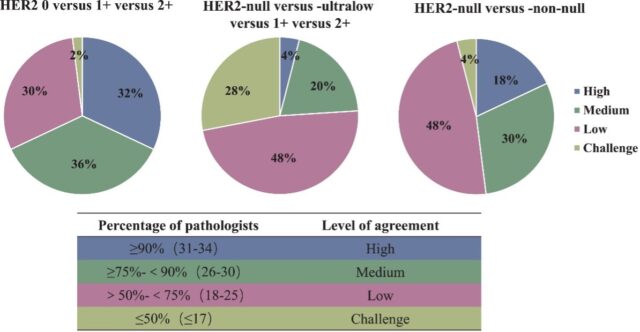
- IHC cannot reliably detect low HER2 expression. Pathologists assess HER2 – a key biomarker in breast cancer – with IHC scoring and reflex in situ hybridization to determine treatment. However, patients with HER2-low and -ultralow expression were marked as faint, incomplete or barely perceptible, leading to inconsistent and inaccurate patient stratification, and posing diagnostic challenges9.
- IHC resulted in poor inter-observer consistency. There is low diagnostic concordance among pathologists using IHC when evaluating HER2-ultralow breast cancer samples (Figure 2). This inconsistent differentiation results in unreliable patient stratification10.
- Hyperion systems offer a more precise alternative. IMC platforms provide a continuous scale of expression, enhanced contrast resolution and greater dynamic range than IHC. They enable objective quantification of biomarkers, overcoming the variability of categorical scoring. IMC technology can also be applied to existing or new IHC slides, allowing for comprehensive tissue reanalysis or expansion of retrospective cohorts.
Learn more about Hyperion services
Conclusion
Selecting the right platform is essential to unlocking meaningful insights in translational research. Our Lab Services offers end-to-end support – from study design through data analysis – leveraging world-class platforms to explore biology at molecular, cellular and spatial levels. With CyTOF and Hyperion technologies, researchers can advance precision medicine by revealing protein signatures that provide a fundamental understanding of disease to aid in the development of better disease detection, risk assessment, monitoring capabilities and therapeutic response. These biomarkers help de-risk development and translate data into impact.
Table 1. Standard BioTools Lab Services platforms
| Platform Measured | Measured Analyte | Multiplexing Capability1 | Sample Type | Application Strengths |
|---|---|---|---|---|
| CyTOF | Protein | 50-plus | Cells, including whole blood | Deep immune cell phenotyping; patient stratification; single-cell analysis for treatment response and mechanistic studies |
| Hyperion Imaging System | Protein | 40-plus | Tissue | Spatial biomarker mapping; links drug exposure to clinical outcomes in tissue-based research; reanalysis of archival slides for retrospective studies |