Morgane Ortis, PhD
Could what happens in the mouth influence what happens throughout the body? Ortis, a scientist at MICORALIS, is helping investigate that question through a series of studies examining how microbial communities change across health and disease.

New research is uncovering a complex ecosystem of bacteria and viruses that could help explain everything from periodontitis to Alzheimer’s disease
For decades, oral health was largely viewed as a local issue. Cavities affected teeth. Periodontitis damaged gums. Dentists treated disease within the mouth, while physicians focused on the rest of the body. As our knowledge of oral health grows, these roles are increasingly integrated.
Researchers are discovering that the oral microbiome – the vast community of bacteria, viruses and other microorganisms that inhabit the mouth – may play a much larger role in human health than previously understood. Links between oral disease and conditions such as cardiovascular disease, diabetes and Alzheimer’s disease continue to emerge, prompting scientists to ask a fundamental question: Could what happens in the mouth influence what happens throughout the body?
At MICORALIS, an oral biology research laboratory affiliated with the Université Côte d’Azur at the Faculty of Odontology in Nice, France, scientist Morgane Ortis, PhD, is helping investigate that question through a series of studies examining how microbial communities change across health and disease.
Ortis is part of a multidisciplinary research team led by Alain Doglio, PhD, director of the MICORALIS laboratory alongside Lilit Tonoyan, PhD, and Robert Marsault. Together, the team investigates the complex interactions between oral microorganisms, viruses, and host biology across a range of oral and systemic health conditions.
With her team, Ortis spans studies of athletes, periodontal disease, viral-bacterial interactions and even the links with neurodegenerative diseases. Together, they paint a picture of an oral ecosystem that is far more dynamic than previously thought.
The oral microbiome: More than just bacteria
When people think of oral infections, they often imagine a single harmful pathogen causing a single disease. “The oral microbiota is made up of more than 1,000 different species,” Ortis explains, “that all exist together as a community. When these microorganisms get out of balance, inflammation and disease can occur.”
One of the foundational concepts in periodontal research comes from the work of Sigmund Socransky, who proposed that periodontal disease arises not from a single bacterial species but from organized groups of bacteria that collectively influence oral health.
“He thought that periodontal disease was not due to only one bacteria,” Ortis says, “but more to an association of different bacteria.”
These groups, known as the Socransky complexes, describe associations among bacteria found in the dental biofilm and their relationship with periodontal health and disease. The earliest colonizers belong to the yellow and green complexes. These bacteria are generally considered commensal organisms that help establish a healthy microbial community. As the biofilm matures, orange complex bacteria emerge, representing a transitional state often associated with gingivitis. These bacteria allow interactions with the red complex that contains four well-established periodontal pathogens frequently associated with periodontitis.
Yet the presence of these pathogens alone does not fully explain disease. “If you have the four bacteria of the red complex, it doesn’t mean that you will have periodontitis,” Ortis says. That observation led researchers to consider another possibility – an association with viruses.
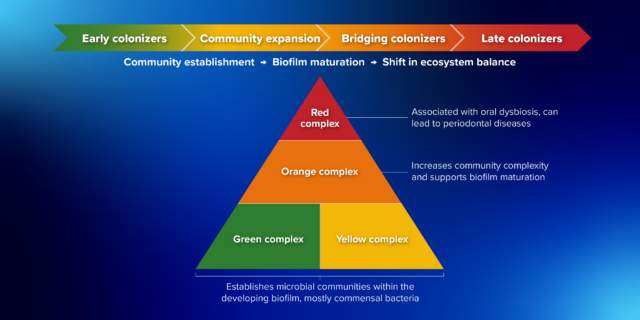
The image above is a conceptual representation of the Socransky bacterial complexes and their relationship to dental biofilm development, illustrating the progression from early colonizers to mature microbial communities associated with dysbiosis and periodontal diseases. Some bacterial species that have been analyzed include:
-
Green complex – Capnocytophaga gingivalis, Granulicatella adiacens, Rothia mucilaginosa
-
Yellow complex – Actinomyces naeslundii, Streptococcus oralis
-
Orange complex – Prevotella intermedia, Fusobacterium nucleatum, Aggregatibacter actinomycetemcomitans
-
Red complex – Porphyromonas gingivalis, Filifactor alocis, Treponema denticola, Tannerella forsythia.
One of the most intriguing hypotheses in oral microbiology is that disease may arise not from bacteria alone, but from interactions between bacteria and viruses. Jorgen Slots and colleagues proposed a theory of viral-bacterial synergy, suggesting that herpes viruses may contribute to periodontal disease progression alongside bacterial dysbiosis.
“They discovered that sometimes the oral microbiota becomes dysbiotic, which may lead to the reactivation of some viruses,” Ortis explains, “causing further dysbiosis and potentially contributing to the progression of periodontitis.” The relationship may also work in reverse. Sometimes, there is a reactivation of viruses in an otherwise balanced microbiota. That reactivation can then disrupt the oral microbiota and potentially contribute to periodontitis. What researchers still don’t know is which event comes first.
One virus receiving particular attention is Epstein-Barr virus (EBV). “About 95% of the global human population is infected with EBV” Ortis says. “But in most people, it remains in a latent state. In periodontitis, we can detect EBV in both latent and lytic states, and there is evidence of increased viral activity.” Why that transition between latency and lytic replication occurs remains unknown, making EBV a central focus of several ongoing studies.
Profiling disease states
Understanding microbial interactions requires more than identifying each species individually. Instead, diseases involve changes across entire microbial communities, so examining the entire community as a whole is important.
For her initial validation study, Ortis looked at how bacterial and viral networks changed across disease states by examining four groups of patients:
- Healthy controls
- Patients with dental caries
- Patients with periodontitis
- Patients with both caries and periodontitis
She created a combined 48-target panel to test for 38 species of bacteria from the Socransky complexes plus nine herpes viruses and one endogenous gene in a single assay.
“It doesn’t mean anything for me to just look at one type of bacteria,” she says. “A large amount of one bacterium doesn’t necessarily mean it has an impact. Sometimes just a few copy numbers of one species can have a bigger impact than another with thousands.”
Using quantitative data generated on the Biomark™ system from this panel testing 136 patients, she built interaction networks that revealed striking differences between groups. “The organization of the oral microbiota was changing according to the oral health condition,” she says.
From those network analyses, unique microbial patterns emerged for each disease category. The findings suggest that oral disease may be better understood as a shift in ecosystem balance rather than the appearance of pathogens.
Extending oral microbiome research beyond oral disease
One ongoing clinical study, ORAMICAL, is investigating potential links between oral microbiota and Alzheimer’s disease. Ortis and team are collecting samples from patients diagnosed with Alzheimer’s, some with periodontitis and some without, to determine whether distinct microbial patterns exist between the groups. “We are able to use our validated bacteria-virus panel on the Biomark system to find differences between the study groups,” Ortis says.
Another trial, involving Tonoyan, examines whether antiviral therapy influences the progression of periodontitis by targeting herpes viruses such as EBV. Together, these studies reflect a growing recognition that oral health may serve as both a marker and a contributor to systemic disease processes.
Why targeted qPCR remains essential
As sequencing technologies continue to evolve, many researchers might assume they are the obvious choice for microbiome studies. Ortis has used sequencing approaches herself but ultimately chose a different path. “I preferred to go back to the Biomark [system],” she says. “I know the species I am looking for.”
The reason comes down to actionable data. Sequencing can identify thousands of organisms, but not all are relevant to a specific biological question. “It was giving so much data that it was hard to see what is important and what is not.”
Instead, Ortis relied on highly targeted quantitative assays.
I wanted fully quantitative results, including standard curves for absolute abundance.
Morgane Ortis, PhD
Equally important was the ability to analyze both bacteria and viruses simultaneously, something that can be challenging using sequencing alone. “If you really want a deep approach for the bacteria, you have to do 16S sequencing. Then if you want viruses as well, you’re basically doubling the experiments.” EBV, in particular, caused trouble initially because a good target hadn’t been selected. After recognizing that the original target failed to capture meaningful variation, Ortis redesigned the assay around a new gene with great results.
The change required adjustment of only a single target rather than an entirely new workflow.
“That’s really cool,” she says of the Biomark platform. “You can design as you want.”
Morgane Ortis, PhD
Assay adaptability has proven valuable across multiple studies. Some projects focus heavily on bacteria, while others examine viruses. Rather than building entirely new workflows and optimizing each time, the Biomark system enables the team to reconfigure targets and sample throughput according to experimental needs.
“For example, we have a study where we are looking only at viruses,” Ortis says. “And for other studies, I’m not using all the bacteria targets all the time because I don’t need them.” This combination of targeted singleplex assay design, quantitative data generation and flexible panel configuration allows the team to rapidly refine hypotheses without being locked into a fixed set of markers. In emerging pathogen research, where new microbial targets continuously arise, that flexibility can be a significant advantage.
Unraveling microbial networks
One thing is becoming increasingly clear: Health and disease emerge from a shifting network of interactions among bacteria, viruses, host biology and environmental factors.
The challenge now is understanding exactly what those shifts mean and how they might be used to detect disease earlier, guide treatment decisions, or even illuminate links between oral health and other systemic conditions. With flexible, quantitative tools that can track both pathogens and the communities they inhabit, the team at MICORALIS is getting closer to understanding how our oral communities may influence overall health.