Helen McGuire and her team out of the University of Sydney leveraged Standard BioTools technology to create a high-parameter panel while introducing much-needed flexibility into their workflows
One of our recent blog posts explored the work of Helen McGuire, PhD, and her team from the University of Sydney – specifically how their research combined with Standard BioTools™ technology is opening new avenues and promoting equity in multi-site research studies.
McGuire and her team used a 38-parameter CyTOF™ panel to identify a blood-based immune signature reported to be associated with differential response to checkpoint therapies targeting the PD-1/PD-L1 pathway in melanoma and lung cancer. The next challenge was to apply these findings in remote settings while also grappling with the challenges of “time, elements, temperature – things that we don’t necessarily have a control for.” In fact, in their previous nationwide study, they had to discard patient samples because of mishandling, temperature fluctuations or samples being delayed somewhere in the workflow due to flight disruptions.
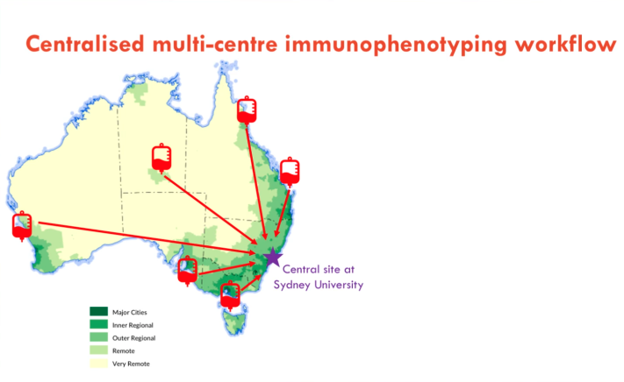
To move beyond this, McGuire and team chose to build on CyTOF innovations, focusing on “thinking about clever study design and integrating it with some new reagent formulations.” One of these innovations is sample barcoding, which allows multiple samples to be processed together minimizing technical variation. The team barcoded samples and added biological spike-ins, which allow for cross-referencing multiple experiments against a spiked-in control. “We can either do live barcoding across CD45 metal-tagged antibodies; we can also do palladium-based metal coding using a barcoding system, and also build this into quality control standardization, which is highly endorsable,” McGuire says.
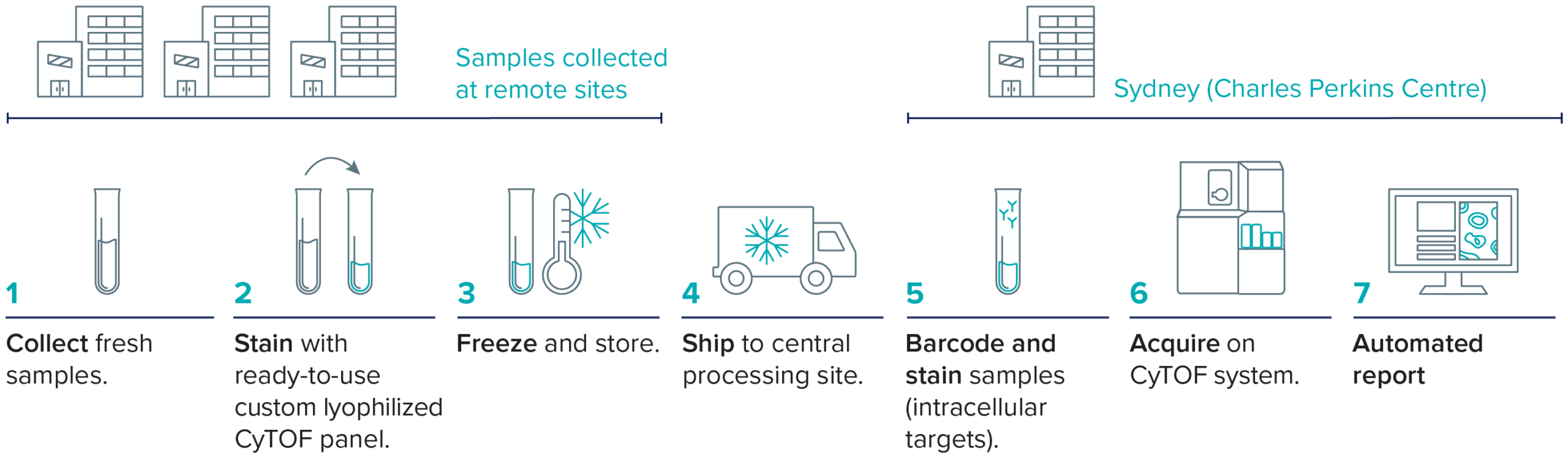
Another innovation unique to CyTOF systems is the ability to cryopreserve stained samples. “It’s actually a way to sensibly press stop on an experiment before you need to rush on and do analysis,” helping ensure stability in protocols and workflows.
One of the latest CyTOF advances is our new LyoMax™ Panels, custom lyophilized antibody cocktails, which remove the variability and burden of onsite liquid antibody preparation, enabling more streamlined and consistent workflows. For the McGuire team, this means no more “franticness [of] preparing your antibodies ahead of an experiment.”
“What we went ahead and did was embed this ethos into a simplified workflow,” McGuire says. The results? The team could integrate “stopping points” throughout the protocol that limited the upfront processing time of their samples, which could then be stored with robust staining ready for analysis. This provided a flexibility not seen with other workflows, meaning researchers didn’t have to make all key decisions at the front end of the protocol: Instead, fresh blood could be stained and cryopreserved, and surface staining of additional markers could be done later at a central site using the stain-freeze-ship workflow.
By integrating these innovations into a single workflow, McGuire and her team had a new model for large-scale immune monitoring; CyTOF technology ultimately allowed the University of Sydney researchers to break down barriers and improve their immunophenotyping workflow. “Because we have all of this information and we can basically map it back to disease status and disease outcomes, we have an opportunity to define better biomarkers,” McGuire says.
Read our previous blog post on McGuire and team promoting equity in research