Learn how Standard BioTools™ technology is being used to advance research into nuclear medicine applications
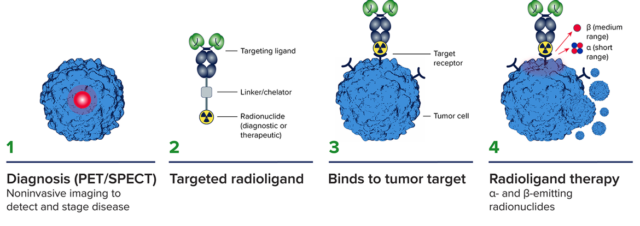
Developing and providing tools for cancer research means reimagining therapies. One approach at the forefront of this field is radioligand therapy (RLT*), a targeted technique that employs the power of radioactive atoms to deliver radiation to targeted cellular populations while limiting exposure to surrounding tissues.
A radioligand is made up of a ligand (a cell-targeting compound) and a radioactive moiety (a unit involving a radioisotope) whose radiation allows for the localization or destruction of specific cells. In the majority of cases, the radioisotopes can be visualized by nuclear medicine imaging techniques to assess the targeting of therapeutic agents, supporting research efforts that could aid in developing successful therapies and provide an advantage over existing approaches.
There are challenges associated with RLT. The domestic availability of radioisotopes is limited, and supply in its early developmental stages can be unreliable. The general public can harbor a negative perception of nuclear medicine and radioactivity; the therapy can also be seen as too complicated. Further, since radioactive isotopes require proper handling and disposal, there is limited knowledge regarding RLT. Specialized handling and operational expertise are required for research involving radioactive materials and healthcare systems should be assessed for readiness.
Despite this, radioligands also provide flexibility for targeted research: Changing the radioisotope can change the experimental application, while changing the ligand can change the disease target (different types of cancer or potentially even a different disease altogether).
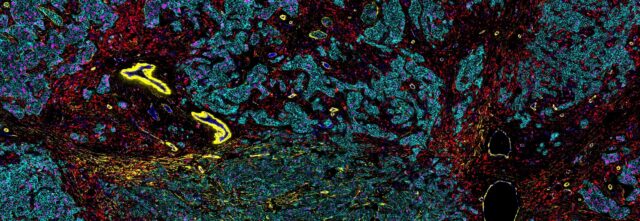
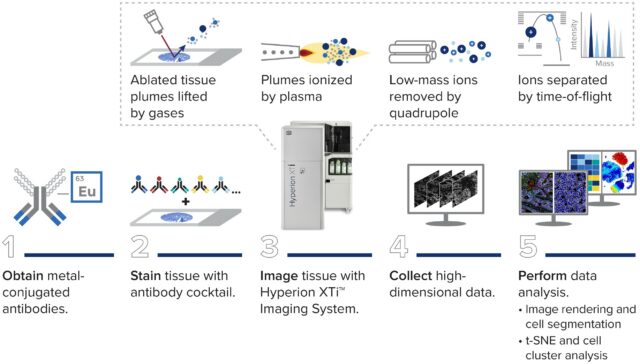
A recent poster by Salazar et al. presented at SITC 2025 demonstrates how IMC™ technology can measure radiopharmaceutical (RPT) metal-based chemotherapies in tissue. Researchers at City of Hope used RPT agents labeled with cold metals to determine whether targeted delivery of radionuclides can help provide specific imaging in cancer. Tissue sections were stained and detected using an IMC panel, and data was acquired using Cell Mode on the Hyperion™ XTi Imaging System. The team found that the use of non-radioactive metal-labeled RPT surrogates is a viable approach for understanding the localization of radionuclides in tissues using IMC technology, emphasizing that assessing the distribution of targeted radionuclides is “essential” for understanding biological and therapeutic effects.
Mass spectrometry-based IMC instruments enable sensitive and accurate multi-element detection and measurements for medium- and long-lived radioisotopes. IMC technology can potentially detect radioisotopes on radioligands and their daughter nuclides if their concentrations are high enough, and can be used to analyze spatial distribution patterns of radioligand-associated signals in treated tissue samples. IMC antibodies, such as the Human Immuno-Oncology IMC Panel, 31 Antibodies, can also help researchers better understand what cell types are present, how those cells respond to RLT and what these changes mean for the tumor and the antitumor response.
Recent publications featuring Standard BioTools technology in RPT research:
- Gómez-Sánchez et al. (EJNMMI Radiopharmacy and Chemistry, 2026) chose single-cell analysis over PET and SPECT to better evaluate radiopharmaceutical uptake and biodistribution to improve understanding of possible heterogeneous uptake in cellular populations and organs. The team found that the sensitivity of CyTOF™ technology allowed for discrimination of uptake between cell models even at low metal-to-antibody stoichiometric ratios. “CyTOF is a robust, high-throughput, multiplexed approach for characterizing the cellular uptake of stable radiopharmaceutical surrogates at single-cell resolution, paving the way for future studies,” the researchers said.
- Zang et al. (Cancers, 2025) wanted to see whether adding radium-223 to enzalutamide would show a boost in the immune systems of people with metastatic hormone-resistant prostate cancer. Immunophenotyping using CyTOF technology was performed to measure PBMC populations before and after treatment. CyTOF assessment was used to determine changes in circulating immune cell population subsets before and after treatment. The researchers found that adding radium-223 did not make the immune systems more active. However, it did increase levels of pSTAT3, a protein that helps cancer become resistant to radiation therapy, meaning that these results could be helpful for future studies aimed at improving this combination regimen.
Read the poster by Salazar et al.
Learn more about how SBI technology is used in immuno-oncology research
* Radioligand therapy (RLT) and radiopharmaceutical therapy (RPT) are both used for these types of therapy, although some groups differentiate between them. Here, RLT is used to encompass both.